
Migraine Triggers and Causes: How to Find Your Personal Pattern
Medically reviewed by Dr. K. Purushothaman, Acupuncture and traditional Siddha medicine practitioner, Kadigai Healthcare, Saligramam, Chennai.
If you live with migraine, you have probably asked yourself the same question many times: why did it start today?
Migraine triggers and causes are two different things. The cause is the way your brain and nervous system are built to react. A trigger is an everyday factor that tips that system into an attack. You can’t change the cause, but you can often learn your triggers.
Most people have more than one trigger, and triggers rarely act alone. A skipped breakfast on its own may do nothing. A skipped breakfast on a hot afternoon after a short night’s sleep may be enough.
This article explains what is known about why migraine happens, the triggers Dr. K. Purushothaman sees most often in patients at Kadigai Healthcare in Chennai, and a simple way to find your own pattern.
Is it really just gas or acidity?
Many people live with migraine for a long time before they call it migraine. They put it down to the stomach, to tired eyes, or to a stressful week. Dr. Purushothaman says this is the misconception he meets most often:
“The most frequent misconception is patients believing it is ‘just gas or acidity’ […] or ‘just a weak eyesight issue.’ While digestive disturbances and eye strain are common triggers, migraine is a distinct neurological condition […].”
The difference matters. When migraine is treated as acidity, the usual response is an antacid and nothing more. The pattern behind the attacks can go unnoticed, and the person keeps meeting the same triggers without knowing it.
What are the main migraine triggers and causes?
Migraine is a neurological condition, not simply a bad headache. The World Health Organization describes it as a primary headache disorder. That means the headache is the condition itself, not a sign of some other illness. Its exact cause is still not fully understood. The HSE describes it as linked to temporary changes in the brain’s chemicals, nerves and blood vessels.
Genes play a large part. According to Ireland’s public health service, the Health Service Executive (HSE), about half of people with migraine have a close relative who also has it. Migraine is also more common in women, which the WHO links to hormonal influences.
So the cause is largely something you are born with. Triggers are different. They are the outside and inside factors that make an attack more likely on a given day, and many of them can be changed.
The Siddha view: Pitha Thalaivali
Siddha medicine describes migraine in its own terms. Dr. Purushothaman explains that in Siddha, migraine is most commonly correlated with Pitha Thalaivali or Oththai Thalaivali, which means one-sided headache. In the Siddha understanding, it starts with an aggravation of Pitha, the body’s thermal and metabolic humour. Pitha rises and disturbs the flow of Vayu, the nervous force, in the head. In this Siddha explanation, the disturbance leads to dilation of the blood vessels in the head, which is felt as throbbing pain.
This is a traditional interpretation, not established neurological science. It sits alongside the modern neurological view rather than replacing it. Both views agree on the practical point: heat, food, sleep and stress can push a sensitive system into an attack.
What is migraine called in Tamil?
In Tamil, migraine is usually called ஒற்றைத் தலைவலி (Oththai Thalaivali), which means “one-sided headache”. In Siddha medicine, it is also correlated with பித்தத் தலைவலி (Pitha Thalaivali).
மைக்ரேன் என்றால் என்ன? மைக்ரேன் (ஒற்றைத் தலைவலி) என்பது ஒரு நரம்பியல் நிலை. இது சாதாரண தலைவலியை விட அதிகமானது. பெரும்பாலும் தலையின் ஒரு பக்கத்தில் துடிக்கும் வலி ஏற்படும்.
ஒற்றைத் தலைவலி ஏன் வருகிறது? மைக்ரேன் உள்ளவர்களுக்கு சில அன்றாட காரணிகள் வலியைத் தூண்டலாம்: உணவைத் தவிர்ப்பது அல்லது தாமதமாக சாப்பிடுவது, வெயில் மற்றும் வெப்பம், சரியான தூக்கமின்மை, அதிக நேரம் திரை பார்ப்பது, மன அழுத்தம். திடீரென கடுமையான தலைவலி வந்தால் உடனே மருத்துவரை அணுகவும்.
Common migraine triggers we see in Chennai
Medical sources list dozens of possible migraine triggers and causes. In practice, a handful come up again and again. These are the five Dr. Purushothaman sees most often in his patients at Kadigai Healthcare:
- Skipped or delayed meals. Long gaps between meals can lead to low blood sugar, which the HSE also lists as a trigger. In these patients, Dr. Purushothaman often sees acidity building up as well.
- Heat and sun exposure. In Chennai’s climate, this one is very dominant. A midday commute, a long wait outdoors or hours in a hot kitchen can all count.
- Poor, erratic or inadequate sleep. Too little sleep, broken sleep and changing bedtimes all play a part.
- Prolonged screen time and eye strain. Long hours on a laptop or phone, often with few breaks.
- Emotional stress and mental overwork. Pressure at work or at home, especially when it runs on for days.
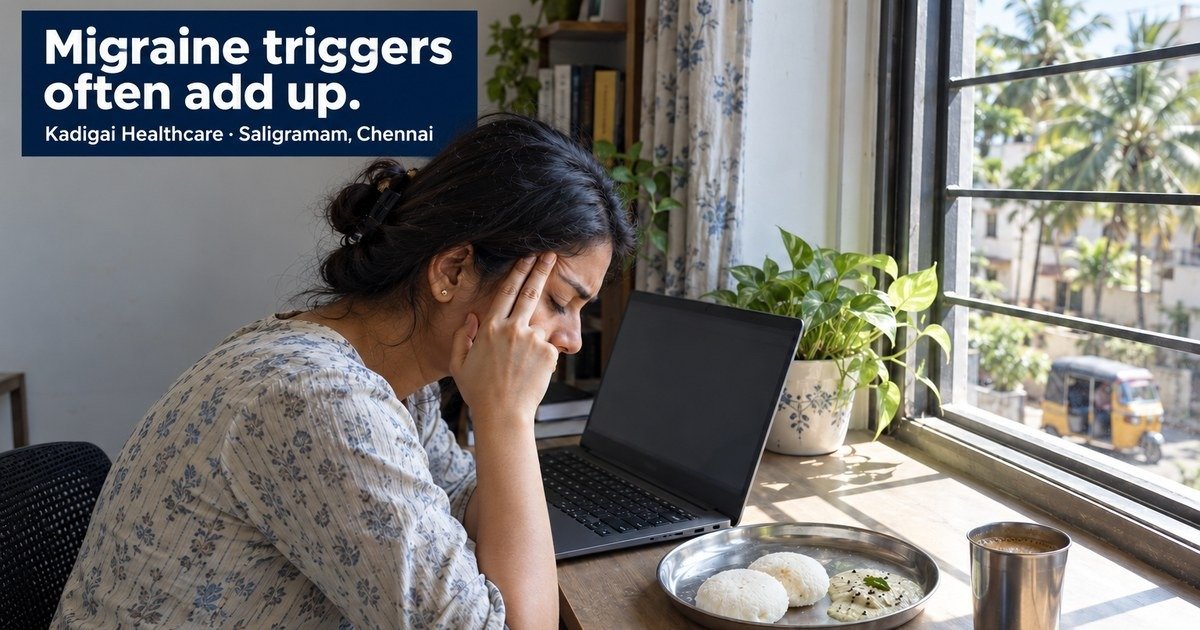
Several of these can overlap in one ordinary working day in Chennai. That is one reason migraine can feel unpredictable. Often it is two or three small triggers adding up, not one big one.
Which foods and eating habits can trigger migraine?
Search for food triggers and you will usually meet the “5 C’s”: chocolate, cheese, caffeine, cola and citrus. The HSE lists similar items: chocolate, citrus fruit, caffeine and tyramine-rich foods such as aged cheese, along with missed meals and dehydration. These lists come largely from Western diets. They are a fair starting point, but they don’t describe what most people in Chennai eat every day.
The habits Dr. Purushothaman asks his patients to watch are closer to home. These come from his clinical observation, not from proven causes, and each person reacts differently:
- Skipping breakfast, long gaps between meals, and fasting without enough water
- Drinking too little water through the day
- Very sour (puli), salty or heavily spiced food
- Deep-fried items
- Too much tea or coffee, or suddenly cutting back on them
- Fermented foods
- Processed and packaged foods with artificial additives
No single food triggers migraine in everyone. Cutting out whole food groups on guesswork rarely helps and can make meals harder to keep regular. The useful step is to notice which foods, if any, show up before your own attacks. We cover everyday eating for migraine in more depth in our article on migraine diet and nutrition.
This section was prepared with Dr. A. Asma, Nutrition and Dietetics, Kadigai Healthcare.
Why do some women get migraine during periods?
Many women notice their migraines follow their monthly cycle. Dr. Purushothaman sees this often in his practice:
“A significant proportion of female patients experience migraine flare-ups closely tied to their menstrual cycle (pre-menstrual or during periods) due to hormonal fluctuations […].”
Medically, this is linked to the natural fall in oestrogen just before a period. The HSE also lists perimenopause and menopause as times when changing hormone levels can affect migraine. In Siddha terms, Dr. Purushothaman explains that Pitha naturally rises during certain phases of the cycle.
If your attacks seem to cluster around your period, add the day of your cycle to your headache diary. Tracking it over a few cycles usually shows whether the link is real for you.
How can you find your personal migraine pattern?
General lists of migraine triggers and causes are only a starting point. Your own list is what counts, and finding it is mostly careful observation. Dr. Purushothaman strongly recommends one simple tool:
“I strongly recommend maintaining a simple headache diary for 2–4 weeks, noting down meal times, sleep quality, daily stressors, weather exposure, and when the pain starts. This makes subtle patterns obvious to the patient.”
A simple headache diary you can use
Copy this layout into a notebook or a notes app. Fill in one row every day, including the days you have no headache.
The first row is a filled-in example. Your own rows start below it.
| Day | Pain started | Meals (times, skipped?) | Sleep | Heat or sun | Screen time | Stress | Tea / coffee / water | Period day | Notes |
| Example: Mon | 3 pm | Breakfast skipped, lunch at 2 pm | 5 hrs, woke twice | 40 min in noon sun | 7 hrs laptop | High | 4 cups tea, little water | Day 26 | Throbbing, left side |
| Tue | |||||||||
| Wed |
Getting the most from your diary
- Write it the same day. Memory fades quickly, especially after a bad attack.
- Record headache-free days too. Without them, you only see half the picture.
- Look for combinations. A trigger that seems harmless on its own may matter when it meets a second one.
- Bring it to your consultation. Two to four weeks of real entries tell a doctor far more than a description from memory.
If you would like help reading your diary, you can bring your entries to a consultation at Kadigai Healthcare in Saligramam, in person or by tele-consultation. Book a consultation at Kadigai Healthcare
What happens at a migraine consultation at Kadigai Healthcare?
At a first consultation, Dr. Purushothaman asks detailed questions about your sleep schedule, meal timings, screen time and exposure to heat and sun. He also asks about digestive health (bowel habits and acidity), and exactly when and where the pain starts.
Alongside your medical care, the clinic’s supportive approach for migraine can include Siddha medicine, Acupuncture, Varma Kalai (a Siddha vital-point therapy), Thokkam (a traditional Siddha physical therapy) and Naturopathy. It can also include Yoga, including breathing practice (pranayama) and postures (asanas).
The plan is based on your own pattern rather than a fixed routine. These therapies are supportive care. They follow, and never replace, proper medical assessment or any treatment your doctor has prescribed.
You can read more about this in our article on how Siddha and Acupuncture may support an individual migraine care plan.
When does a headache need urgent medical attention?
Headaches are very common, but some are a sign of something more serious. Seek urgent medical care if you have:
- A sudden, severe “thunderclap” headache
- Weakness, numbness or drooping of the face
- Slurred speech or difficulty communicating
- Sudden vision loss or double vision
- High fever with a stiff neck or confusion
- A headache that starts after a head injury
- A dramatic change in your usual headache pattern or intensity, especially after the age of 50
Dr. Purushothaman advises an imaging scan (MRI or CT) when red-flag symptoms are present or when headaches keep getting worse despite treatment. He also advises one when neurological changes are found during examination, or when someone develops a new one-sided headache later in life.
If you notice any of the signs above, go to an emergency department or see a neurologist first. Supportive care can be discussed once serious causes have been ruled out.
Frequently asked questions
What foods trigger migraines the most?
Health services such as the HSE list chocolate, citrus, caffeine and aged cheese among possible food triggers, and popular lists add cola to make the “5 C’s”. In Chennai, Dr. Purushothaman more often sees skipped meals, too little water, very sour, salty or spicy food, fried items, too much tea or coffee, and packaged foods. Food triggers vary from person to person, so a headache diary is the best way to find yours.
Is it normal to get migraines on your period?
Yes, it is common. Many women have migraine attacks just before or during their period, linked to the natural drop in oestrogen at that time.
Dr. Purushothaman sees this pattern in a significant share of his female patients. Noting your cycle day in a headache diary helps confirm the link. Speak to a doctor if the attacks are new, severe or changing.
Can you get migraine every day?
Some people do have headaches on most days, and this needs proper medical assessment rather than self-treatment. According to the WHO, frequent use of headache medicines can itself cause more headaches, known as medication-overuse headache.
A daily headache that is new, or that keeps getting worse, should be checked by a doctor promptly, as it may need a scan.
Why does migraine happen on one side of the head?
Migraine pain is often one-sided, which is why its Tamil name, Oththai Thalaivali, means one-sided headache. It can also switch sides or affect both.
A new one-sided headache that starts later in life should be checked by a doctor, as Dr. Purushothaman advises a scan in that case.
Which doctor should I see for migraine in Chennai?
For diagnosis, start with a general physician, who can refer you to a neurologist if needed. With any of the warning signs above, seek urgent care. Once serious causes are ruled out, many patients also look for supportive care.
Kadigai Healthcare in Saligramam offers Siddha medicine and Acupuncture as supportive care for migraine, alongside conventional care, starting from your own trigger pattern. Bring your headache diary and any reports to your first visit.
Are migraines hereditary?
Often, yes. About half of people with migraine have a close relative who also has it, according to the HSE. Inheriting the tendency does not mean you will have frequent attacks.
Triggers such as missed meals, poor sleep, heat and stress still shape how often attacks happen, which is why learning your own pattern is so useful.
Migraine treatment in Saligramam, Chennai
Kadigai Healthcare is a Siddha and Acupuncture clinic in Saligramam, Chennai, within easy reach of Vadapalani, KK Nagar, Virugambakkam, Valasaravakkam and Kodambakkam. If you want help working out your own migraine triggers and causes, a consultation at Kadigai Healthcare starts from your own pattern. It also covers whether Siddha treatment for migraine, Acupuncture or the other supportive therapies above suit you, alongside your existing medical care.
Consultations are available in person in Saligramam or by tele-consultation. Bring your headache diary if you have started one. Book a consultation at Kadigai Healthcare or call +91 99408 33662.
About Dr. K. Purushothaman
Dr. K. Purushothaman practises Acupuncture and traditional Siddha medicine at Kadigai Healthcare, with 11+ years of experience. His practice also draws on Varma Kalai, Thokkam and Naturopathy. His approach to migraine starts with the patient’s own pattern: meals, sleep, heat, screens and stress, looked at together rather than one at a time. As he puts it, “Every symptom is a message, not the disease itself.”
This article is for general information only and is not a substitute for a personal consultation. Please see a qualified doctor for diagnosis and treatment of your condition.
How this article was prepared: The medical content in this article is based on Dr. K. Purushothaman’s own clinical experience and the reliable published sources cited below. AI helped draft and organise the text. Every clinical statement was reviewed and approved by Dr. K. Purushothaman before publishing.
Sources