The Antibiotic Apocalypse: Can We Reduce Unnecessary Antibiotic Use?
Antimicrobial resistance is changing the way the world thinks about infection. Can prevention, responsible prescribing, and appropriately integrated healthcare help protect the antibiotics we still rely on?
Imagine a future in which a routine bacterial infection becomes increasingly difficult to treat because the antibiotics that once worked reliably no longer work.
That future is not science fiction.
Antimicrobial resistance (AMR) is one of the major challenges facing global health. It occurs when microorganisms—particularly bacteria—develop the ability to survive medicines that were previously effective against them. As resistance increases, infections can become harder to treat, treatment options can become more limited, and the risk of complications can increase.
But there is an important distinction that is sometimes lost in conversations about AMR:
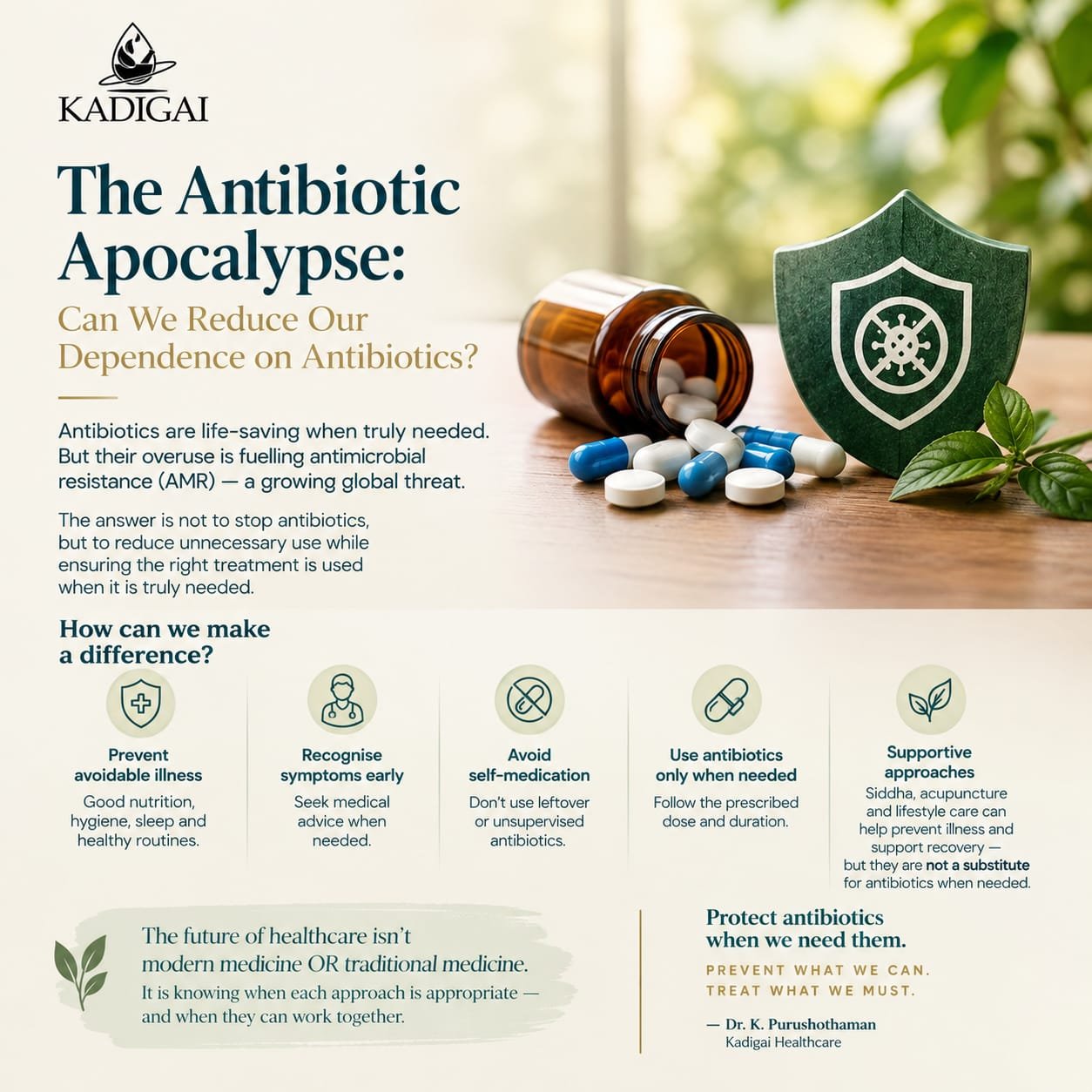
The problem is not antibiotics. The problem is unnecessary and inappropriate antibiotic use.
Antibiotics remain among the most important medicines in modern healthcare. When a bacterial infection genuinely requires antibiotic treatment, the appropriate medicine can be life-saving.
So the goal should never be to simply “stop antibiotics.”
The better question is:
How can we reduce unnecessary antibiotic use while ensuring that people receive the right treatment when antibiotics are genuinely needed?
That question sits at the heart of antimicrobial stewardship.
Antibiotics are powerful medicines—and they need to be used responsibly
An antibiotic is not a general treatment for being unwell.
Fever, cough, sore throat, body ache or fatigue are symptoms, not diagnoses. The underlying cause may be infectious or non-infectious, and even among infections, the cause may differ.
Some illnesses are caused by bacteria. Others are caused by viruses or other microorganisms. In some situations, supportive care and observation may be appropriate; in others, investigation or specific medical treatment may be necessary.
This is why clinical assessment matters.
Common behaviours that can contribute to inappropriate antibiotic use include:
- Taking antibiotics for viral illnesses when antibiotics are not indicated
- Taking antibiotics without appropriate medical evaluation
- Using leftover antibiotics from an earlier illness
- Taking someone else’s prescribed antibiotics
- Expecting antibiotics for every fever, cough or sore throat
- Changing, stopping or extending a prescribed antibiotic course without discussing it with the treating clinician
The answer is therefore not fear of antibiotics.
It is better decision-making about when antibiotics are appropriate and when they are not.
Antimicrobial resistance is bigger than one patient’s prescription
It is easy to think of antibiotic use as an individual decision:
“I have an infection, so I need an antibiotic.”
But antimicrobial resistance is a broader public-health issue.
When antibiotics are used unnecessarily or inappropriately, they can contribute to the selection and spread of resistant microorganisms. Resistant organisms can then make future infections more difficult to manage—not only for the person taking the medicine, but potentially for other people and communities as well.
This is why antimicrobial stewardship matters.
Stewardship means using antimicrobial medicines thoughtfully:
the right medicine, for the right patient, for the right indication, at the right time, and for an appropriate duration according to clinical guidance.
It also means recognising when an antimicrobial medicine is not the appropriate intervention.
Prevention is one of the most important ways to reduce avoidable antibiotic use
Reducing unnecessary antibiotic use does not mean rejecting modern medicine.
It means strengthening prevention and early healthcare practices so that avoidable illness and inappropriate self-medication are reduced.
Important foundations include:
- Good personal and environmental hygiene
- Appropriate vaccination and infection-prevention measures
- Balanced nutrition
- Adequate sleep and recovery
- Regular physical activity appropriate to the individual
- Management of relevant chronic health conditions
- Timely medical assessment when symptoms are concerning
- Avoiding unnecessary self-medication
- Following professional medical advice when antibiotics are prescribed
- Understanding when supportive care is appropriate and when medical treatment is necessary
Prevention cannot eliminate every infection.
But prevention, early recognition, responsible prescribing and appropriate treatment can collectively reduce avoidable healthcare burden.
Where can Traditional Siddha medicine fit?
This is where an integrative healthcare perspective requires careful thinking.
Traditional Siddha medicine has historically placed considerable emphasis on diet, daily routines, individual constitution, environmental influences and adaptation to seasonal changes.
Traditional concepts such as Kaala Muraimai reflect the importance given to adapting aspects of diet and lifestyle according to seasonal and environmental conditions.
From a modern preventive-health perspective, some of these principles can provide an interesting framework for thinking about everyday health behaviour, nutrition, routine and resilience.
But there is an essential boundary:
A traditional preventive-health philosophy should not be confused with treatment of a serious bacterial infection.
Siddha medicine should not be promoted as a substitute for antibiotics when a bacterial infection has been appropriately diagnosed and antibiotic treatment is clinically indicated.
Nor should traditional remedies be used to delay necessary medical evaluation.
The responsible role of traditional medicine is to operate within its appropriate scope, while recognising when conventional investigation and treatment are necessary.
Can traditional medicine help reduce unnecessary medication use?
This question deserves a more nuanced answer than either “yes” or “no.”
A healthcare approach that places greater emphasis on prevention, nutrition, lifestyle, sleep, daily routine and individualised care may help address some of the factors that influence overall health and healthcare-seeking behaviour.
However, that does not mean that traditional medicine can prevent every infection, replace antimicrobial therapy or eliminate the need for conventional healthcare.
Good integrative practice requires knowing the difference between:
supporting health
and
treating a disease that requires specific medical intervention.
That distinction is critical.
What about acupuncture?
Acupuncture may have a complementary role for selected health conditions and aspects of wellbeing when used appropriately.
However, an integrative practitioner must also recognise its limitations.
Acupuncture should not be used as a substitute for appropriate assessment or treatment of a potentially serious infection.
If a patient has symptoms that require investigation, antimicrobial treatment or other medical intervention, those needs must take priority.
Acupuncture and other complementary approaches may sometimes be considered alongside appropriate medical care, depending on the individual clinical situation.
The question should therefore not be:
“Can acupuncture replace antibiotics?”
The more responsible question is:
“Does acupuncture have an appropriate complementary role in this particular patient, at this particular stage of illness?”
That is a very different way of thinking about integrative medicine.
Integrative medicine is not about choosing one system over another
One of the misconceptions about integrative healthcare is that it means combining every available therapy.
It does not.
Integrative medicine should not mean using every therapy available; it means understanding which approach has a reasonable role, for which person, at what stage of illness—and when it should not be used.
Sometimes the appropriate approach may be prevention and lifestyle support.
Sometimes it may be observation and supportive care.
Sometimes it may require laboratory investigations or imaging.
Sometimes antibiotics may be necessary.
And sometimes a complementary therapy may have a role alongside conventional treatment.
The skill lies in recognising the difference.
What I believe as an integrative practitioner
In clinical practice, I believe the most important question is not:
“Which medical system should we choose?”
It is:
“What does this person need at this point in their illness?”
Every patient brings a different combination of symptoms, history, lifestyle, environment, expectations and health needs.
That is why responsible integrative healthcare should not be built around the idea that one system can treat everything.
It should be built around clinical judgement, appropriate referral, responsible use of medicines, prevention and individualised care.
Traditional medicine has valuable knowledge and long-standing health philosophies.
Modern medicine has powerful diagnostic tools, medicines, procedures and emergency interventions.
Neither becomes stronger by pretending the other does not exist.
The patient benefits when we understand where each approach belongs—and where it does not.
The future of healthcare: prevention without abandoning treatment
The conversation around antimicrobial resistance gives us an opportunity to rethink healthcare more broadly.
Can we improve prevention?
Can we reduce unnecessary self-medication?
Can we educate patients about when antibiotics are appropriate?
Can we identify illness earlier?
Can traditional systems contribute responsibly to preventive health and wellbeing?
Can complementary therapies be used where evidence and clinical judgement support their role?
And, equally importantly:
Can we recognise the situations in which conventional medical treatment is essential?
These are better questions than asking whether modern medicine or traditional medicine is “better.”
Healthcare should not be a competition between systems.
It should be a disciplined effort to provide appropriate care for the individual patient.
Protect antibiotics. Prevent what we can. Treat what we must.
Reducing antimicrobial resistance is not about abandoning antibiotics.
It is about protecting their effectiveness for people who genuinely need them.
It means resisting the temptation to treat every symptom with medication.
It means preventing what can reasonably be prevented.
It means seeking appropriate medical assessment when warning signs appear.
It means respecting both the potential and the limitations of traditional and complementary healthcare.
And above all, it means understanding that good integrative healthcare is not about replacing one system with another.
It is about knowing when to support, when to investigate, when to refer, when to treat—and when not to intervene unnecessarily.
The future of healthcare is not necessarily:
Modern medicine OR traditional medicine.
It is about responsible clinical judgement and appropriate care.
Protect antibiotics when we need them.
Prevent what we can.
Treat what we must.
That is more than a tagline.
It is the discipline good medicine requires.
— Dr. K. Purushothaman
Traditional Siddha | Integrative Healthcare
Kadigai Healthcare, Chennai