
Medically reviewed by Dr. K. Purushothaman, Acupuncture and traditional Siddha medicine practitioner (11+ years in practice), Kadigai Healthcare, Saligramam, Chennai · Last updated 26/11/2026
“Doctor, I feel tired throughout the day, but when I go to bed, I just cannot fall asleep.”
Dr. K. Purushothaman hears this often at Kadigai Healthcare in Saligramam. He hears it in Tamil too: “டாக்டர், தூங்கணும்னு நினைக்கிறேன், ஆனா தூக்கமே வர மாட்டேங்குது.” (Doctor, I want to sleep, but sleep just won’t come.)
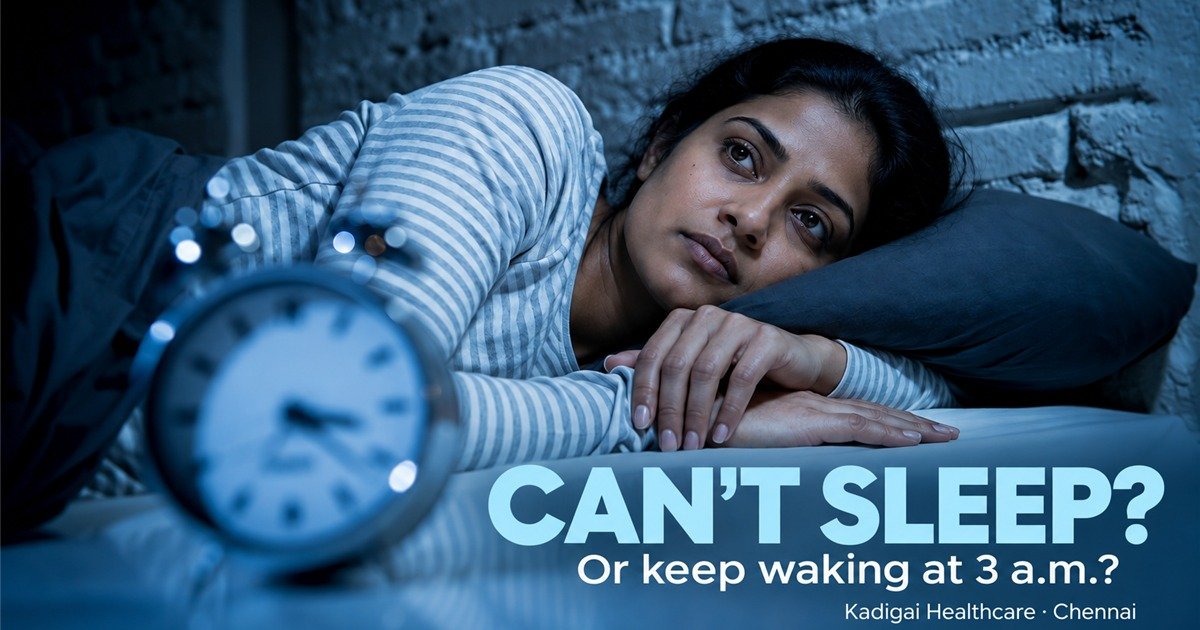
If that sounds familiar, insomnia may be part of the picture. This article explains what insomnia is and why adults struggle to fall asleep or keep waking at night. It also covers how a doctor works out what is behind it, and which signs mean you should get help rather than wait.
What is insomnia, and what are the symptoms?
Insomnia is a sleep problem in which you have trouble falling asleep, staying asleep, or you wake earlier than you want, even though you have enough time to sleep. Almost everyone has a bad night now and then. It is called chronic insomnia when the trouble happens at least three nights a week, has lasted three months or more [1], and causes real distress or gets in the way of daily life [2].
Insomnia is not only a night-time problem. People with insomnia often feel tired, find it hard to concentrate, feel low or irritable, and struggle to function at work or at home the next day [3].
Three common patterns
- Trouble falling asleep: you lie awake for a long time after going to bed.
- Waking repeatedly: you fall asleep but wake several times and struggle to drift off again.
- Waking too early: you wake well before you need to and cannot get back to sleep.
Dr. Purushothaman starts by asking which of these describes you, because each points the conversation in a different direction.
Why can’t I sleep at night even when I’m tired?
Feeling exhausted and still lying awake is one of the most frustrating parts of insomnia. Dr. Purushothaman explains it this way:
“Sometimes, the problem is not simply a lack of sleep; it is difficulty switching off an overactive mind and nervous system.”
That is why he does not reach for a quick fix first. In his words: “When I hear this, I don’t immediately focus on giving something to induce sleep. First, I try to understand why the person is unable to sleep.”
Many things can keep sleep away, and often more than one is involved:
- Stress, worry and a mind that keeps replaying the day.
- Irregular sleep times, shift work or night-time caregiving.
- Screens and bright light late in the evening [4].
- Tea, coffee or other caffeine later in the day.
- Alcohol, and eating or drinking within a few hours of bedtime, especially heavy, fatty or sugary food [4].
- Pain, some medicines and other health conditions.
Doctors also look for treatable conditions that can sit behind poor sleep. These include depression, pain, an enlarged prostate, sleep apnea and restless legs syndrome [3].
How a doctor works out what is behind your sleep problem
When a patient says, “I can’t sleep at night,” Dr. Purushothaman works through a short set of questions:
- When does the problem start? Do you struggle to fall asleep, or fall asleep easily but wake in the middle of the night?
- How often? Is it occasional, or almost every night?
- How long? Did it start recently, or has it continued for several months?
- What happens when you wake? Is it hard to fall asleep again? Do you wake with racing thoughts or anxiety?
- How do you feel the next morning? Refreshed, or tired, with headaches, irritability or poor concentration?
- Any associated symptoms? Loud snoring, breathing interruptions, leg discomfort, frequent urination or pain?
He also asks about stress levels, medicines, caffeine, screen exposure, physical activity and medical history. As he puts it, he tries “to understand what is happening in their life emotionally and physically.”
Two patients who both wake at 3 a.m.
Dr. Purushothaman uses a simple example to show why these questions matter. Two people can wake at the same hour for completely different reasons.
“One patient may wake up with persistent thoughts about work, family responsibilities and financial pressure.” For this person, he explores stress management, relaxation techniques, sleep habits and the possible role of psychological support.
“Another patient may wake up repeatedly with dry mouth, headaches and daytime tiredness, along with a history of loud snoring.” Here, his concern changes: “I would be concerned about possible sleep-disordered breathing and recommend an appropriate medical sleep assessment rather than simply suggesting relaxation techniques.”
“A patient may come to us saying, ‘I cannot sleep,’ but our responsibility is to understand why.”
Why a sleep diary helps
Dr. Purushothaman sees the sleep diary as “more than a record of sleeping hours. It helps us understand the relationship between a person’s daily activities, emotional state, physiological responses and sleep quality.”
Keep a simple diary for one or two weeks. Each day, note:
- When you went to bed, and roughly how long it took to fall asleep.
- How often you woke, and when you got up.
- Any daytime naps.
- When you had tea, coffee or alcohol, and any medicines taken.
- How you felt the next day.
You do not need exact times. Rough estimates are enough to show a pattern.
What is the best treatment for insomnia?
CBT-I: the recommended first treatment for chronic insomnia
Cognitive behavioural therapy for insomnia (CBT-I) is the first treatment recommended for adults with chronic insomnia by the American College of Physicians [3]. The American Academy of Sleep Medicine also strongly recommends it, and it usually runs over four to eight sessions [5].
Dr. Purushothaman stresses that CBT-I “is not simply counselling or general relaxation. It is a structured programme that generally includes:”
- Stimulus control: rebuilding the association between bed and sleep.
- Sleep restriction therapy: carefully adjusting time spent in bed to improve sleep efficiency.
- Cognitive therapy: addressing fear, worry and unhelpful thoughts about sleep.
- Relaxation techniques: reducing physiological and mental arousal.
- Sleep education: understanding how sleep is regulated and which habits support it.
Sleep restriction can make you sleepier during the day at first, so it should be planned with a trained clinician rather than tried on your own. If CBT-I may suit you, ask a physician, psychiatrist or sleep specialist where you can access it.
One point surprises many people. Sleep hygiene tips on their own (a dark room, no screens, a fixed bedtime) are not considered an effective stand-alone treatment for chronic insomnia [5]. They help, but they work best as part of a fuller plan.
Practical daily changes that fit your life
Dr. Purushothaman encourages small, achievable habits:
- A consistent wind-down routine.
- Less screen exposure before sleep.
- Gentle breathing and relaxation exercises.
- Regular physical activity at appropriate hours.
- Balanced meal timings.
- Adequate exposure to natural daylight.
If you drink tea or coffee in the evening, moving your last cup earlier is a simple place to start. For shift workers, he adapts these recommendations to their actual working hours rather than insisting on a conventional daytime routine.
“We should not force patients to fit into a perfect sleep routine. We should develop a realistic sleep routine that fits their lives while protecting their health.”
Sleeping tablets, melatonin and herbal products
“Sleeping tablets are not the only answer to insomnia,” says Dr. Purushothaman. When CBT-I alone has not helped, doctors may consider medicine, weighing benefits, harms and costs with the patient [3].
If you already take sleeping tablets, melatonin, or herbal or Siddha products, tell your doctor about all of them. Dr. Purushothaman involves the prescribing clinician when:
- There is no satisfactory improvement despite medication.
- The patient has excessive daytime drowsiness or other adverse effects.
- Multiple medicines or herbal products are being combined.
- There are concerns about tolerance, dependence or withdrawal.
- The patient wishes to reduce or stop prescribed medication.
“I strongly advise patients not to discontinue sleeping tablets abruptly or change their dosage independently. Medication changes should be coordinated with the prescribing clinician.”
Where acupuncture and Siddha fit at Kadigai
At Kadigai Healthcare, Dr. Purushothaman may include acupuncture, traditional Siddha medicine, lifestyle guidance and relaxation practices in a sleep care plan, as supportive care after a proper assessment. They do not replace medical evaluation, CBT-I or treatment from a specialist.
It is fair to be clear about the evidence. A Cochrane review found that research on acupuncture for insomnia is not rigorous enough to support or refute its use [6]. Siddha medicine is a traditional system, and its approach to sleep comes from that tradition rather than from the kind of trial evidence behind CBT-I. Both are offered as supportive care within an individual plan, never in place of care you need elsewhere. If you take Siddha or other herbal products, tell every doctor treating you.
When should you see a doctor about sleep?
Some people assume poor sleep is just part of getting older or of modern stress. Dr. Purushothaman disagrees: “Persistent sleep disturbances should never be ignored.”
He sorts sleep complaints into three levels of concern: routine medical referral, prompt medical evaluation and urgent medical attention. As a general guide:
| Level | Signs | What to do |
| See a doctor | Poor sleep on most nights that is not settling, or that is affecting how you function during the day | Consult a doctor and start a sleep diary |
| Prompt medical evaluation | Loud snoring, pauses in breathing or gasping for air during sleep; strong daytime sleepiness [7]. An uncomfortable urge to move your legs in the evening [8]. Problems with sleeping tablets | See a doctor soon; a sleep study may be needed. Do not drive if you feel drowsy |
| Urgent help | Someone is in immediate danger, has harmed themselves or may act on thoughts of suicide. Thoughts of self-harm, or a sudden, severe change in mood or behaviour | Immediate danger: call 112 now [9] or go to the nearest emergency department, and do not leave the person alone. Urgent support: call Tele-MANAS on 14416 (free, 24/7) [10] |
Dr. Purushothaman is clear about the limits of supportive care:
“I would never try to manage suspected sleep apnoea, dangerous daytime sleepiness or severe psychiatric symptoms with acupuncture or relaxation techniques alone. These patients need appropriate medical assessment.”
He also keeps checking as treatment goes on. If daytime fatigue, repeated awakenings or worsening sleep continue despite the recommended measures, he reconsiders the assessment.
He looks for sleep apnoea, restless legs syndrome, thyroid problems, chronic pain, medication-related sleep disturbances, depression and anxiety. “If new warning signs appear, I don’t simply continue the same treatment plan. I recommend appropriate medical evaluation or specialist referral.”
Frequently asked questions
Can insomnia be cured quickly or permanently?
No honest treatment can promise a quick or permanent fix. Chronic insomnia usually improves step by step, as the factors keeping it going are identified and addressed.
The recommended first treatment, CBT-I, typically takes four to eight sessions [5]. Be cautious about products or programmes that promise fast results. If your sleep has been poor for weeks, a doctor’s assessment is the most useful first step.
Is seven hours of sleep enough?
Most adults need at least seven hours of sleep each night [4]. But hours alone do not tell the whole story. As Dr. Purushothaman puts it, “a person may spend eight hours in bed but experience repeated awakenings, sleep apnoea or other disturbances that prevent restorative sleep.” If you are still tired during the day despite enough time in bed, mention it to a doctor.
Why can’t I sleep at night all of a sudden?
A sudden change in sleep often follows a new stress, a change in work hours, travel, illness, pain or a new medicine. Short bouts of poor sleep can settle once the trigger passes. If it continues for more than a few weeks, keeps getting worse, or comes with low mood, see a doctor. Loud snoring, breathing pauses or strong daytime sleepiness also need a doctor’s assessment [7].
Consult a doctor at Kadigai Healthcare, Saligramam
If you struggle to fall asleep or keep waking at night, Dr. K. Purushothaman at Kadigai Healthcare can assess your sleep and the factors around it. In his words, his approach is “to listen carefully, understand the underlying factors and create an individualised treatment strategy […]” and, where needed, to recognise “when specialist intervention is necessary.” Read more about Dr. K. Purushothaman.
Bring a list of every medicine, supplement and herbal product you take, any recent medical reports, and your sleep diary if you have kept one. The clinic serves Saligramam and nearby areas including Vadapalani, Virugambakkam, Valasaravakkam, Kodambakkam, Ashok Nagar and Arumbakkam.
Kadigai Healthcare
2E, K.C. Flats, 20/2, Velayudham Colony 1st Street, Kannabiran Nagar, Saligramam, Chennai 600093
Phone: +91 99408 33662
To consult a doctor, call the clinic or send a message through the Kadigai Healthcare contact page.
Disclaimer: This article is for general information only and is not a substitute for a personal consultation. Please see a qualified doctor for diagnosis and treatment of your condition.
How this article was prepared: The medical content in this article is based on Dr. K. Purushothaman’s own clinical experience and the reliable published sources cited below. AI helped draft and organise the text. Every clinical statement was reviewed and approved by Dr. K. Purushothaman before publishing.
Sources
- American Academy of Sleep Medicine. 13th annual Insomnia Awareness Night brings attention to chronic insomnia implications, treatment (June 2026). aasm.org
- US Department of Veterans Affairs and Department of Defense. The Management of Chronic Insomnia Disorder and Obstructive Sleep Apnea: clinician pocket card (2025). healthquality.va.gov
- American College of Physicians. ACP recommends cognitive behavioral therapy as initial treatment for chronic insomnia (2016). acponline.org
- Centers for Disease Control and Prevention. About sleep and your heart health. cdc.gov
- American Academy of Sleep Medicine. New guideline supports behavioral, psychological treatments for insomnia. aasm.org
- Cochrane. Acupuncture for insomnia (CD005472, 2022). cochrane.org
- National Heart, Lung, and Blood Institute. Sleep apnea symptoms. nhlbi.nih.gov
- National Institute of Neurological Disorders and Stroke. Restless legs syndrome. ninds.nih.gov
- Ministry of Home Affairs, Government of India. Emergency Response Support System (ERSS 2.0) Guidelines (January 2026). mha.gov.in
- Directorate General of Health Services, Government of India. National Mental Health Programme (Tele MANAS). dghs.mohfw.gov.in