
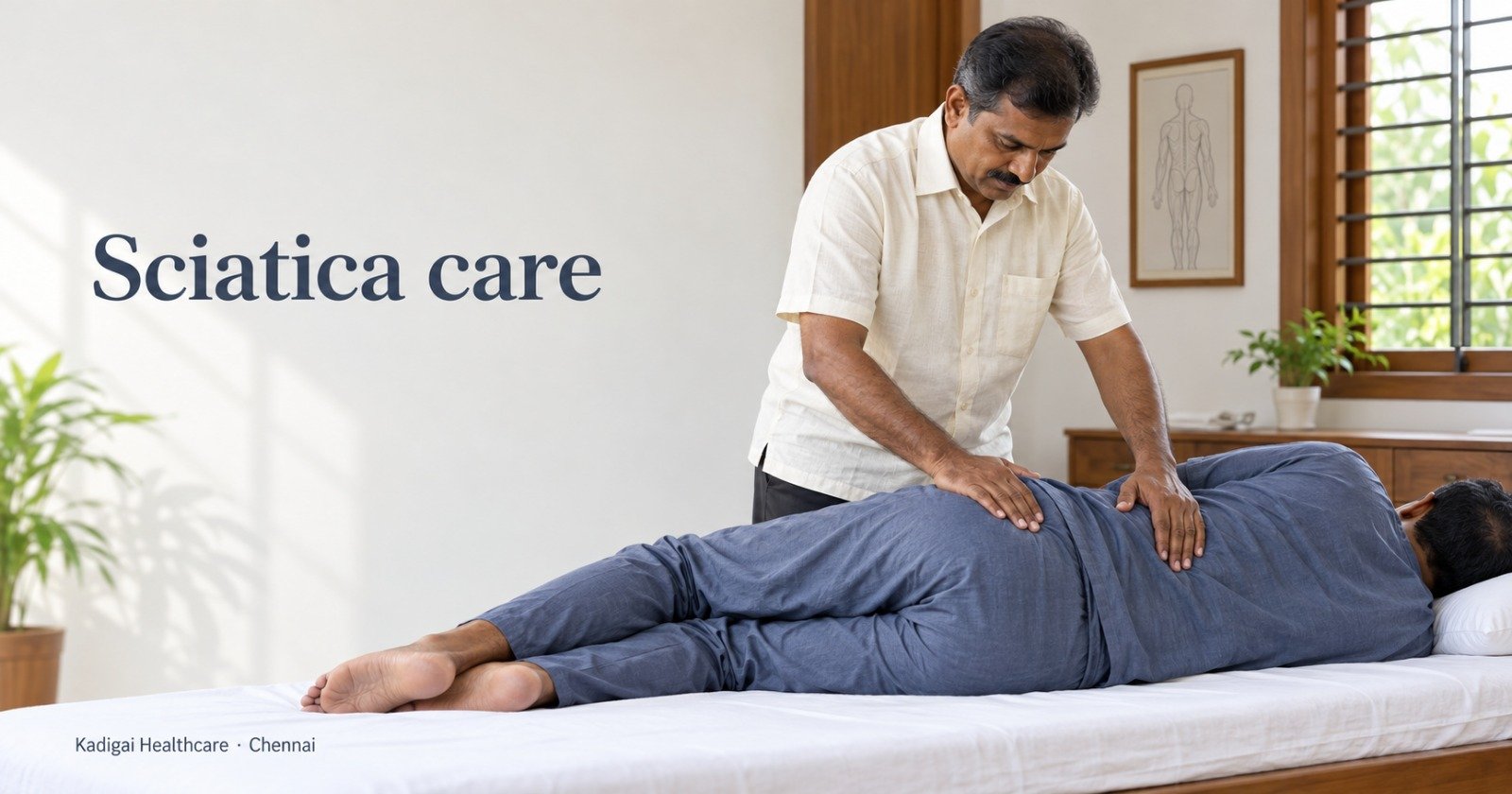
Sciatica Treatment With Siddha, Varma Kalai and Acupuncture: What It Can and Cannot Do
Sciatica rarely stays in the back. It starts low in the spine and runs down through the buttock into the leg, sometimes as far as the foot. Sitting through a meeting becomes hard. Riding a two-wheeler becomes harder. Many people have already tried painkillers and rest, and some have been told they have a disc bulge and wonder whether surgery is the only option left.
If you are looking into sciatica treatment beyond tablets, this guide explains what sciatica is and how long it usually takes to settle. It also covers how Siddha medicine, Varma Kalai and acupuncture are used to support recovery at Kadigai Healthcare, and what these approaches cannot do.
What is sciatica?
Sciatica is not a disease in itself. It is the name for pain caused when the sciatic nerve is pressed on or irritated. This nerve begins in the lower back, passes through the buttock and runs down the back of each leg. When it is irritated, pain can travel along that whole path.
According to the NHS guidance on sciatica, the most common cause is a slipped disc. This is when the soft cushion between two spinal bones bulges and presses on the nerve. Narrowing of the spinal canal and a spinal bone slipping out of position are other causes. Back pain on its own, without pain travelling into the leg, is usually not sciatica.
In Tamil, sciatica is simply written as சியாட்டிகா, and the pain as சியாட்டிகா வலி. In Siddha medicine, the condition is described as பேராசன நரம்பு தாபிதம் (Perasana Narambu Thabitham), an irritation of the major nerve of the lower back and pelvic region. It is classed among Vatha disorders, under the broader heading of Vathasthambam (வாதஸ்தம்பம்). Read this guide in Tamil
What does sciatica feel like?
Most people feel pain in the buttock and down the back of one leg. It can be sharp, shooting or burning. Tingling, pins and needles, numbness or weakness in the leg or foot are common too. The pain often gets worse with coughing, sneezing or long periods of sitting.
Dr. Purushothaman sees a clear pattern in patients at the clinic:
“In my clinical practice, I often observe that prolonged sitting and long hours of two-wheeler riding may contribute to sciatica symptoms. However, the immediate trigger that brings the patient to the clinic is often lifting a heavy object, either at work or at home. Therefore, it is important to identify both the underlying contributing factors and the immediate trigger.”
Dr. K. Purushothaman
How long does sciatica take to heal?
This is the question patients ask most. The NHS notes that sciatica usually gets better within a few weeks to a few months, though it can last longer. Many people improve on their own, without surgery, especially when they stay gently active.
How long it lasts depends on what is pressing on the nerve and how severe the pressure is. A mild flare after a long drive may ease within days or weeks. Pain that lasts more than about three months is usually described as chronic sciatica.
That still leaves a long stretch of pain to live with, and some cases keep returning. This is where people often look for support beyond painkillers, and where an individual assessment helps decide what is worth trying.
How Siddha medicine approaches sciatica
Siddha medicine, one of the traditional systems of medicine practised in Tamil Nadu, looks at the person as a whole rather than treating the leg pain in isolation. Dr. K. Purushothaman describes his approach this way:
“Every symptom is a message, not the disease itself.”
Dr. K. Purushothaman
In practice, a Siddha assessment for sciatica looks at your posture, daily routine, digestion, sleep and work habits alongside the pain itself. The aim is to understand what keeps the nerve irritated and what is slowing recovery.
Treatment is matched to how severe the sciatica is. In his words:
“For mild to moderate cases, I may use external therapies such as Thokkam and Varma Kalai techniques. However, I avoid these therapies in more severe cases, particularly when there is suspected internal tissue injury or significant inflammation, until the patient has been appropriately evaluated.”
Dr. K. Purushothaman
Thokkam (தொக்கணம்) is a traditional Siddha manual therapy. Internal Siddha medicines are prescribed only after an individual assessment, with the aim of managing pain and inflammation and supporting healing where appropriate. As Dr. Purushothaman puts it, the key is to assess the severity of the condition and choose the treatment accordingly, rather than applying the same approach to every patient.
Varma Kalai and disc bulge: an honest view
Varma Kalai is a Siddha system of treatment based on specific vital points in the body. At Kadigai Healthcare, it is used for spinal discomfort alongside Siddha medicine and acupuncture.
If you are looking for Varma treatment for sciatica, it helps to know what it can realistically do. Many patients with a disc bulge arrive hoping a therapist can push the disc back into place. Dr. Purushothaman is direct about this:
“In patients with disc bulge, I don’t claim that Varma Kalai can simply ‘put the disc back in place.’ The approach is about managing pain, reducing muscular restriction and improving functional movement, along with appropriate exercise and lifestyle guidance.”
Dr. K. Purushothaman
When the muscles around the lower back and hip stay tight and guarded, movement becomes stiff and painful. Varma Kalai techniques aim to ease that restriction and help you move with better balance, while exercise and changes to daily habits do their part over time. Unlike acupuncture, which has been tested in a randomised trial for sciatica (see below), Varma Kalai has very little published clinical research so far. Its use rests on traditional Siddha practice and clinical experience. You can read more about the approach on our Varma Kalai page.
Acupuncture for sciatica: what the research shows
Acupuncture uses very fine needles placed at specific points in the body. For sciatica, there is some encouraging research, though it is still limited.
A 2024 randomised trial published in JAMA Internal Medicine followed 216 adults with long-standing sciatica caused by a herniated disc. Half received 10 sessions of acupuncture over four weeks, and half received sham (placebo) acupuncture. The acupuncture group reported a larger reduction in leg pain, and the difference was still present a year later.
It is one trial, carried out in hospitals in China, and the acupuncturists knew which treatment they were giving. So it is promising rather than final. At Kadigai Healthcare, acupuncture is used as one part of a plan, not as a promise of a fixed result.
What sciatica treatment at Kadigai Healthcare involves
Your first visit starts with a detailed history. Dr. Purushothaman asks where the pain starts and where it travels, what makes it better or worse, how long it has lasted and what you have already tried. He also checks for numbness, weakness or other signs that need a different kind of care first. Please bring any scan reports you already have.
Depending on what the assessment shows, a plan may combine Siddha medicine, Varma Kalai and acupuncture, along with advice on sitting, sleeping, lifting and daily movement. The mix is different for each person.
These approaches work alongside conventional medical care, not instead of it. If another doctor has prescribed medicine for your sciatica, continue to follow their advice about it. If your symptoms suggest you need a scan or a surgical opinion, you will be told so.
Some findings change the plan straight away. Signs of significant nerve pressure include progressive leg weakness, foot drop (difficulty lifting the front of the foot) and the emergency signs listed below. If the assessment shows any of these, Dr. Purushothaman does not start routine treatment. “I would refer such patients immediately rather than begin routine treatment,” he says. Scans such as an MRI are guided by what the examination shows and by specialist advice, rather than ordered routinely for everyone.
If you would like to talk through your own symptoms, you can book a consultation at the clinic in Saligramam.
What is the fastest way to heal sciatica?
There is no shortcut, and any promise of an overnight fix deserves caution. What helps most people recover is treatment combined with daily habits that stop aggravating the nerve:
- Stay gently active. Short walks are usually better than long periods of rest in bed.
- Break up sitting every 30 to 45 minutes, and support the curve of your lower back when you do sit.
- Sleep on your side with a pillow between your knees, or on your back with a pillow under your knees.
- Bend your knees rather than your back when lifting, and keep loads close to your body.
- On a two-wheeler, slow down well before speed breakers and stop to stretch on longer rides.
Our guide to choosing the right ergonomic support for back pain covers chairs, mattresses and pillows in more detail.
Common misconceptions about sciatica
“Complete bed rest is the best treatment.” For most people, staying gently active helps recovery more than lying down for days. The NHS advises keeping up normal activities as far as you can.
“A slipped disc can be pushed back in by massage or Varma.” As Dr. Purushothaman says above, the aim of Varma Kalai is to manage pain and improve movement, not to reposition the disc.
“Sciatica always ends in surgery.” Many cases improve without an operation. Surgery is usually considered when symptoms are severe, keep getting worse or have not improved with other treatment, and that decision belongs with a spine surgeon.
When sciatica needs urgent medical care
Most sciatica is not dangerous, but some signs need prompt medical attention. See a doctor soon if the pain is getting worse, has not improved after a few weeks, or is stopping you from doing everyday activities. Leg weakness that keeps increasing, or foot drop, also needs prompt evaluation.
Go to an emergency department straight away if you have any of these:
- Sciatica in both legs at the same time.
- Weakness or numbness in both legs that is severe or getting worse, or weakness in a leg that is worsening rapidly.
- Numbness around the genitals, groin or buttocks (the saddle area).
- Difficulty starting to pass urine, or loss of control of your bladder or bowels.
These symptoms need emergency assessment, not complementary treatment. Please do not drive yourself.
Preparing for your consultation
A little preparation makes the first visit more useful. Note where the pain starts and how far down the leg it travels, whether you have numbness or weakness, and what makes it better or worse. List the treatments you have tried, including medicines, physiotherapy and rest. Bring any MRI or X-ray reports, and the names of medicines you currently take.
Frequently asked questions
How long does a sciatica flare-up usually last?
Many flare-ups ease within a few days to a few weeks, and most sciatica improves within a few weeks to a few months.
Pain lasting more than about three months is usually called chronic. If a flare is not settling after a few weeks, is getting worse or keeps returning, it is worth having it assessed.
What are the signs that sciatica is healing?
Common signs include leg pain easing or moving back up towards the lower back, and less tingling or numbness.
Sitting, walking, bending, dressing and climbing stairs also start to feel easier. Progress is rarely a straight line, so a bad day does not always mean you are going backwards.
Can sciatica be cured completely?
Many people recover fully, especially when the cause is a disc bulge that settles with time. No system of medicine, traditional or modern, can honestly guarantee a permanent cure for everyone, and sciatica can return.
At Kadigai Healthcare, Siddha medicine, Varma Kalai and acupuncture aim to ease pain and improve movement, alongside conventional care where needed. Advice on daily habits may also help reduce flare-ups.
How many acupuncture sessions are needed for sciatica?
There is no fixed number for everyone. In the 2024 trial described above, people received 10 sessions over four weeks.
How many you need depends on how long you have had sciatica, what is causing it and how you respond to the first few sessions.
Dr. Purushothaman will suggest a plan after your assessment and review it as you go.
Can sciatica cause numbness or weakness in the leg?
Yes. Pressure on the nerve can cause tingling, numbness or weakness in the leg or foot. Mild symptoms on one side are common.
Weakness that is getting worse, symptoms in both legs, or numbness around the genitals or buttocks need urgent medical assessment the same day.
Which doctor should I consult for sciatica?
Start with a doctor who will take a full history and examine you, including checks for numbness and weakness. Many people also consult practitioners of Siddha medicine, Varma Kalai or acupuncture for support with pain and movement.
If your symptoms are severe or getting worse, an orthopaedic or spine surgeon should assess you first.
Sciatica treatment in Saligramam, Chennai
If sciatica has been limiting your sitting, sleep or daily work, an assessment can help you understand what is driving it and what may help. For sciatica treatment in Chennai, Dr. K. Purushothaman at Kadigai Healthcare in Saligramam uses Siddha medicine, Varma Kalai and acupuncture to support people with sciatica, alongside advice on daily habits. The clinic is easy to reach from Vadapalani, Virugambakkam, Valasaravakkam, Kodambakkam, Ashok Nagar and T. Nagar.
If you are comparing options, our article on acupuncture vs physiotherapy for chronic pain may help. When you are ready, book a consultation.
Why honesty matters in sciatica care
People with sciatica hear many promises, from oils that dissolve a disc bulge to a guaranteed cure in a set number of sessions. Kadigai Healthcare does not make those promises. Dr. Purushothaman’s training spans Siddha medicine, Varma Kalai and acupuncture, and he is clear about what each can and cannot do.
Care starts with an assessment of how your body moves and compensates. From there you get a plan built for you, and a straight answer if your symptoms need a different kind of care.
This article is for general information only and is not a substitute for a personal consultation. Please see a qualified doctor for diagnosis and treatment of your condition.