What traditional gold-based preparations are, how pharmaceutical processing is understood, what traditional medicine says about their uses, and what modern science can—and cannot—establish.
Quick Answer: What Is Thanga Bhasma?
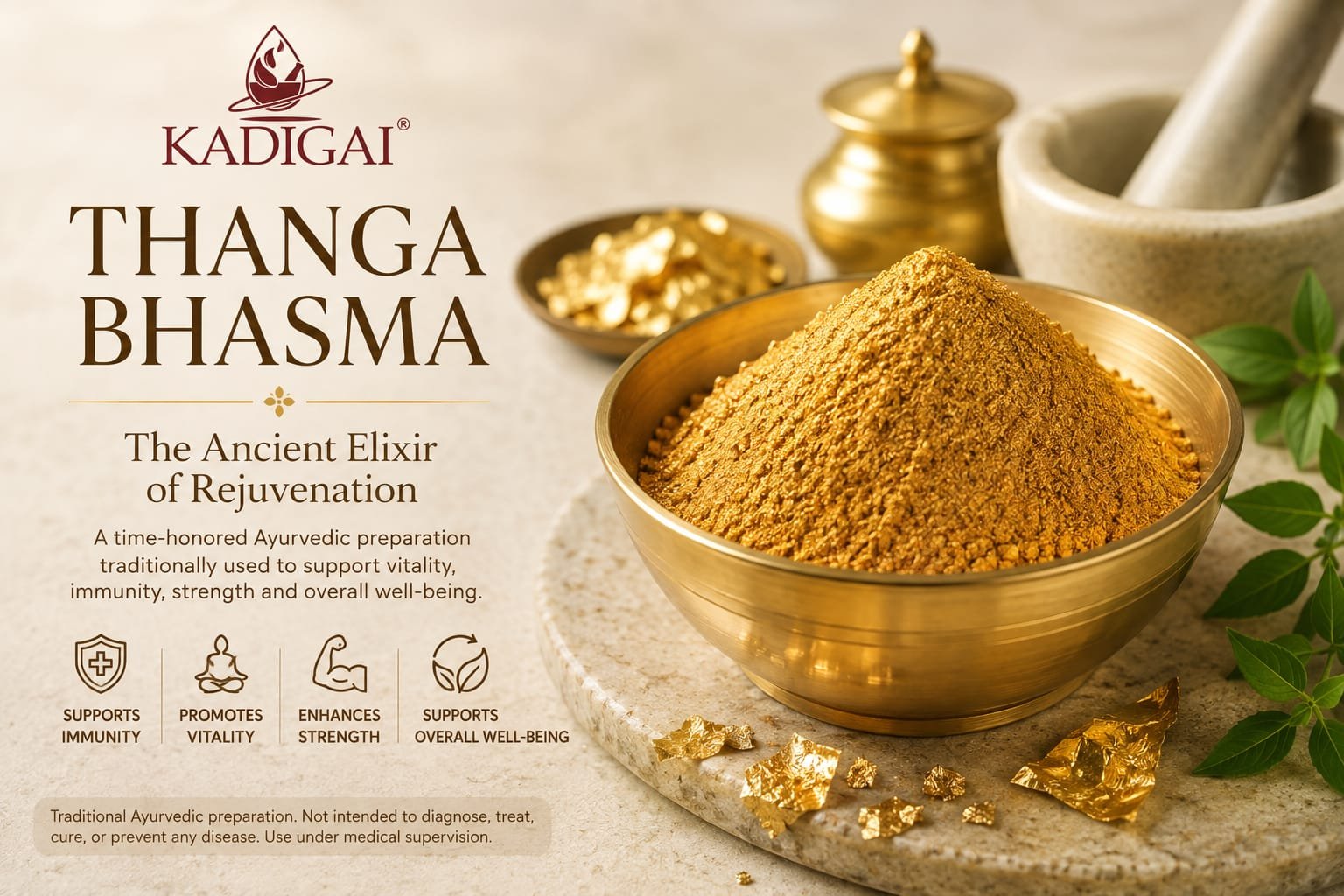
Thanga Bhasma is a traditionally processed gold-based medicinal preparation associated with Indian systems of traditional medicine. It is not simply raw metallic gold. Traditional pharmaceutical processing may involve purification, grinding or levigation, controlled heating, calcination, and other prescribed procedures.
However, traditional use and modern clinical evidence are not the same thing. Scientific studies may help characterize a preparation’s composition and physical properties, but questions about clinical effectiveness, appropriate dosage, long-term safety, toxicity, interactions, and suitability for an individual patient require appropriate pharmacological, toxicological, and clinical research.
Because metal- and mineral-based formulations can involve specific quality and safety considerations, Thanga Bhasma should not be self-prescribed.
Introduction
Gold has held an important place in several traditional medical systems for centuries. Yet traditional medicine did not necessarily approach gold as something to be consumed simply in its raw metallic form.
Traditional pharmaceutical systems developed elaborate methods for processing metals and minerals before they were incorporated into medicinal preparations. These processes may include purification, repeated trituration or levigation, controlled heating, calcination, and formulation with prescribed substances.
Thanga Bhasma is a term commonly encountered in the broader Indian tradition of metal-based pharmaceutical preparations, particularly in Ayurvedic and Rasa Shastra literature. Gold is also discussed within Siddha medicine as a processed medicinal substance, although terminology, classification, pharmaceutical procedures, and classical references can differ between traditional systems.
This distinction is important when discussing Thanga Bhasma in Siddha medicine.
A traditionally processed preparation should not simply be equated with raw gold. At the same time, the fact that pharmaceutical processing changes a material’s physical or chemical characteristics does not automatically prove that the resulting preparation is clinically effective or safe.
This is where traditional knowledge and modern scientific evaluation need to meet.
What Is Thanga Bhasma?
Thanga Bhasma generally refers to a traditionally processed gold-based preparation rather than ordinary metallic gold.
The term “bhasma” is particularly associated with Ayurvedic and Rasa Shastra pharmaceutical terminology. In Siddha medicine, gold-based preparations are described within the system’s own pharmaceutical classifications and terminology.
Therefore, the exact identity, ingredients, processing method, and intended use of a gold-based preparation should always be understood in relation to its specific traditional system, classical reference, formulation, and manufacturing process.
Traditional pharmaceutical processing may involve:
Authentication and selection of raw materials
Prescribed purification or preliminary processing
Processing with specific botanical, mineral, or other media
Repeated grinding or trituration
Controlled heating or calcination
Repeated pharmaceutical cycles where prescribed
Final preparation according to the relevant classical method
The precise process can vary according to the formulation, classical source, practitioner, and manufacturer.
Why does processing matter?
Processing can alter measurable properties of a material, including:
Particle size and distribution
Surface characteristics
Chemical composition
Chemical form
Crystalline structure
Morphology
Trace-element profile
Potential contaminants
Modern materials science provides tools to study these changes.
But an important distinction remains:
A change in physical or chemical properties is not, by itself, proof of therapeutic benefit.
Traditional Uses of Thanga Bhasma and Gold-Based Preparations
Gold-based medicinal preparations have a long history within Indian traditional medical literature.
Depending on the specific formulation, classical reference, and medical tradition, gold preparations have historically been associated with concepts such as:
Vitality and strength
Rejuvenative or restorative care
Support during periods of debility
Cognitive and mental wellbeing
Reproductive wellbeing
General resilience and recovery
These associations belong to the history and practice of traditional medicine.
They should not automatically be interpreted as modern clinical indications.
Traditional use is not the same as clinical evidence
This distinction is essential.
There are several different levels of evidence:
Traditional documentation
Evidence that a traditional medical system describes or uses a formulation.
Pharmaceutical evidence
Information about how the preparation is manufactured and what it contains.
Laboratory evidence
Findings from chemical, cellular, or experimental studies.
Clinical evidence
Evidence from appropriately designed human studies measuring meaningful health outcomes.
These are not interchangeable.
A formulation may have a long history of traditional use while still requiring modern research to establish its efficacy, dosage, safety profile, pharmacology, and suitability for specific medical conditions.
How Is Thanga Bhasma Traditionally Prepared?
Traditional preparation of a metal-based medicinal formulation is more complex than simply converting gold into a fine powder.
Depending on the formulation and medical system, pharmaceutical processing may involve a sequence of purification, grinding, heating, calcination, and other prescribed procedures.
From a modern scientific perspective, researchers may investigate whether such processing produces measurable changes in:
Elemental composition
Particle morphology
Particle-size distribution
Surface chemistry
Crystalline structure
Chemical form
Trace-element profile
Potential contaminants
Batch-to-batch consistency
The exact pharmaceutical procedure should be understood from the appropriate classical reference and validated manufacturing context, rather than inferred from generic descriptions found online.
For this reason, detailed preparation instructions should not be treated as a DIY procedure.
What Modern Science Can—and Cannot—Tell Us
Modern analytical science can provide valuable information about traditional metal- and mineral-based preparations.
Depending on the formulation and research methodology, researchers may investigate:
Elemental composition
Purity
Morphology
Particle characteristics
Chemical structure
Surface properties
Potential contaminants
Manufacturing consistency
This helps answer:
What is actually present in the preparation?
But another question is much more difficult:
Does the preparation provide a meaningful clinical benefit to people, and is that benefit greater than its potential risks?
That requires a much stronger evidence base.
Laboratory characterization alone cannot establish:
Whether a preparation effectively treats a specific disease
Appropriate therapeutic dosage
Long-term safety
Human bioavailability
Clinically meaningful effectiveness
Drug–herb or drug–mineral interactions
Safety in pregnancy or breastfeeding
Safety in children
Safety in people with kidney or liver conditions
Whether different commercial batches have equivalent properties
These questions require appropriate toxicological, pharmacological, pharmacokinetic, and clinical research.
What About “Gold Nanoparticles” in Thanga Bhasma?
Online discussions sometimes describe gold-based traditional formulations as “gold nanoparticles” or “ancient nanomedicine.”
Scientific studies can investigate whether nanoscale particles or structures are present in particular preparations.
However, the presence of nanoscale material does not automatically mean that a preparation is a clinically proven nanomedicine.
Particle size is only one characteristic.
Biological behaviour can also depend on:
Chemical composition
Surface chemistry
Particle morphology
Aggregation
Dose
Impurities
Route of administration
Manufacturing conditions
Therefore:
A nanoscale observation can be scientifically interesting without automatically proving therapeutic effectiveness.
This distinction is especially important when communicating traditional medicine to patients.
Is Thanga Bhasma Safe?
The word “traditional” does not automatically mean “risk-free.”
Likewise, a traditional purification procedure should not be interpreted as an automatic guarantee that every modern commercial preparation is free from contamination or manufacturing variability.
For metal- and mineral-based formulations, quality assurance is particularly important.
1. Raw-material authenticity
The identity, purity, origin, and quality of the starting material matter.
2. Pharmaceutical processing
Traditional processing should be carried out according to an appropriate and documented pharmaceutical method by suitably trained personnel.
3. Manufacturing controls
Controlled manufacturing processes can help reduce variability between batches.
4. Quality testing
Appropriate analytical testing can help assess identity, composition, purity, and potential contamination.
5. Batch consistency
Products carrying the same or similar name should not automatically be assumed to have identical composition or characteristics across manufacturers.
6. Clinical appropriateness
Even a properly manufactured preparation may not be appropriate for every individual.
Product quality and clinical appropriateness are separate questions.
Can Thanga Bhasma Be Self-Prescribed?
No.
Thanga Bhasma and other metal- or mineral-based traditional formulations should not be self-prescribed based solely on internet information, social-media recommendations, advertisements, or testimonials.
A qualified practitioner should consider factors such as:
The individual’s symptoms and diagnosis
Age and overall health
Existing medical conditions
Current medicines and supplements
Pregnancy or breastfeeding where relevant
Kidney and liver health where clinically relevant
Identity and quality of the formulation
Dose and duration
Potential interactions
Contraindications
Whether conventional medical evaluation is required
The principle is simple:
The treatment should be appropriate for the individual—not simply popular for the condition.
How Should Patients Evaluate a Traditional Metal-Based Formulation?
Before considering a metal- or mineral-based traditional formulation, patients can ask:
What exactly is the formulation?
Ask for its precise name, ingredients, pharmaceutical form, and traditional reference where applicable.
Who prepared or manufactured it?
Consider whether it comes from an appropriately regulated and quality-controlled source.
Has the product been tested?
Ask what quality and contamination testing has been performed and whether appropriate documentation is available.
Why has it been recommended?
The reason for use should be clinically understandable rather than based only on broad claims such as “detox,” “boosting immunity,” or “cure-all” promises.
What dose and duration are appropriate?
Do not assume that higher doses or longer use are automatically better.
Could it interact with existing treatment?
Tell the practitioner about all prescription medicines, over-the-counter medicines, supplements, and traditional formulations being used.
These questions support informed healthcare rather than blind acceptance or blanket rejection.
The Kadigai Approach: Tradition With Rigor
At Kadigai Healthcare in Chennai, we believe traditional medicine deserves neither blind acceptance nor automatic dismissal.
It deserves careful examination.
Our approach is built around three questions.
1. What does the tradition actually describe?
Classical knowledge should be understood within its original pharmaceutical and clinical context rather than reduced to modern marketing claims.
2. What can be objectively verified?
Where analytical, pharmacological, toxicological, or clinical evidence exists, it should be considered.
Where evidence remains limited or uncertain, that uncertainty should be acknowledged.
3. Is it appropriate for this individual?
A traditional formulation should never be considered in isolation from the patient.
The person’s health status, symptoms, diagnosis, current treatment, formulation quality, potential risks, and clinical goals all matter.
This reflects the broader Kadigai Healthcare philosophy of integrative care: respect traditional knowledge while maintaining clinical responsibility, transparency, and patient safety.
Siddha Medicine in Chennai: A Responsible Approach
For patients exploring Siddha medicine in Chennai, the most important consideration is not simply finding a traditional formulation.
It is finding an appropriate clinical approach.
Traditional formulations should be considered within a broader assessment that takes into account the patient’s individual circumstances, existing treatment, health history, and potential risks.
At Kadigai Healthcare, our approach to Siddha and integrative care focuses on individual assessment rather than one-size-fits-all treatment.
The goal is not to replace necessary medical care with traditional medicine.
The goal is to understand where traditional approaches may have a role, where evidence supports their use, where evidence remains limited, and when further medical evaluation is necessary.
Why Evidence Does Not Diminish Tradition
Traditional knowledge and scientific evidence do not have to be opposing forces.
Respecting a medical tradition does not require presenting every traditional claim as scientifically established.
Likewise, asking for evidence does not require dismissing centuries of pharmaceutical knowledge and clinical observation.
A more productive framework is:
Traditional knowledge can preserve observations and generate questions.
↓
Pharmaceutical science can investigate preparation and composition.
↓
Modern research can investigate mechanisms, safety, pharmacology, and clinical outcomes.
↓
Clinical practice can determine whether an approach is appropriate for an individual.
This is not a rejection of tradition.
It is a pathway toward responsible understanding.
The Evidence Standard Traditional Medicine Deserves
Traditional medicine does not need louder claims.
It needs:
Better documentation
Stronger quality systems
Better raw-material authentication
Transparent manufacturing
Independent safety evaluation
Better research
Responsible clinical communication
Informed patients
A mature evidence pathway could involve:
Preserving traditional pharmaceutical knowledge
↓
Documenting classical preparation methods
↓
Authenticating raw materials
↓
Standardizing manufacturing processes
↓
Characterizing the finished preparation
↓
Assessing contaminants and toxicological risks
↓
Investigating pharmacological effects
↓
Studying dosage and pharmacokinetics
↓
Conducting well-designed human clinical research
↓
Integrating findings into responsible clinical practice
This approach protects two things simultaneously:
the patient
and
the integrity of the tradition.
Frequently Asked Questions About Thanga Bhasma
Is Thanga Bhasma the same as raw gold?
No. Thanga Bhasma refers to a traditionally processed medicinal preparation rather than simply consuming metallic gold. Processing can change the physical and chemical characteristics of the starting material.
What are the traditional uses of Thanga Bhasma?
Traditional gold-based preparations have historically been associated with concepts such as vitality, rejuvenation, recovery from debility, and other traditional therapeutic purposes. Exact uses depend on the formulation, medical system, and classical reference.
How is Thanga Bhasma prepared?
Traditional preparation may involve prescribed pharmaceutical processes such as purification, grinding or levigation, heating, calcination, and repeated processing cycles. Exact procedures vary by formulation and traditional reference and should not be treated as DIY instructions.
Is Thanga Bhasma scientifically proven to treat diseases?
Traditional use or laboratory findings alone should not be presented as proof that a preparation treats a specific disease in humans. Clinical effectiveness needs to be established through appropriate human research.
Does Thanga Bhasma contain gold nanoparticles?
Some studies of gold-based traditional preparations may investigate nanoscale particles or structures. However, finding nanoscale material does not by itself establish that a preparation is a clinically proven nanomedicine.
Is Thanga Bhasma safe?
Safety depends on the specific formulation, manufacturing quality, contaminants, dose, duration, individual patient factors, and possible interactions. Metal- and mineral-based formulations should not be self-prescribed.
Can Thanga Bhasma be taken with modern medicines?
Potential interactions depend on the specific formulation and medicines involved. A qualified healthcare professional should review the complete treatment plan before combining therapies.
Should Siddha medicine replace modern medical treatment?
Not necessarily. Traditional medicine and modern healthcare do not have to be treated as mutually exclusive. Appropriate care should consider the patient’s condition, available evidence, safety considerations, and clinical needs.
Where can I consult a Siddha physician in Chennai?
Patients seeking Siddha and integrative healthcare in Chennai can consult qualified practitioners for individualized assessment and guidance. At Kadigai Healthcare, traditional approaches are considered within a broader patient-centred framework that emphasizes responsible care and safety.
A More Mature Future for Siddha Medicine
The future of Siddha medicine should not be defined by choosing between tradition and science.
It can be defined by bringing the strengths of both into a more responsible framework.
Traditional knowledge offers a vast body of pharmaceutical concepts, formulations, observations, and clinical experience.
Modern science offers tools for characterization, standardization, toxicology, pharmacology, and clinical evaluation.
Neither needs to become the other.
Instead, they can meet through better questions, transparent research, rigorous quality standards, and patient-centred clinical practice.
That is how traditional medicine can evolve without losing its identity.
And that is how evidence can strengthen—not diminish—the traditions we seek to understand.
Conclusion
Thanga Bhasma provides an important case study in how traditional metal-based medicines should be understood.
The right question is not simply:
“Does tradition say it works?”
Nor is it:
“Can modern science immediately explain everything about it?”
The better questions are:
What does the traditional literature actually describe?
How is the preparation produced?
What can analytical science verify about its composition and characteristics?
What safety concerns need to be investigated?
What does human clinical evidence demonstrate?
What remains uncertain?
And most importantly:
Is this particular preparation appropriate for this particular patient?
The future of Siddha and other traditional medical systems will not be built on exaggerated claims.
It will be built on preserved knowledge, better standards, transparent research, responsible practitioners, informed patients, and evidence proportionate to the claims being made.
That is not a compromise between tradition and science.
It is a more mature way of respecting both.
Consult Kadigai Healthcare in Chennai
Have questions about Thanga Bhasma, Siddha medicine, or another traditional formulation?
Kadigai Healthcare provides Siddha and integrative healthcare consultations in Chennai, with an emphasis on individualized assessment, responsible traditional medicine practice, and patient safety.
Consult a qualified practitioner before considering any metal- or mineral-based formulation.
Medical Disclaimer: This article is intended for educational purposes and discusses traditional pharmaceutical concepts and historical associations. Traditional uses should not be interpreted as established clinical outcomes. The safety and effectiveness of any metal- or mineral-based formulation depend on its identity, preparation, quality, dose, duration of use, and individual patient factors. Such formulations should not be self-prescribed. This article does not replace professional medical advice, diagnosis, emergency care, or treatment from a qualified healthcare professional.